
AI / VOIP / COMMUNICATION PLATFORM
Callchestra
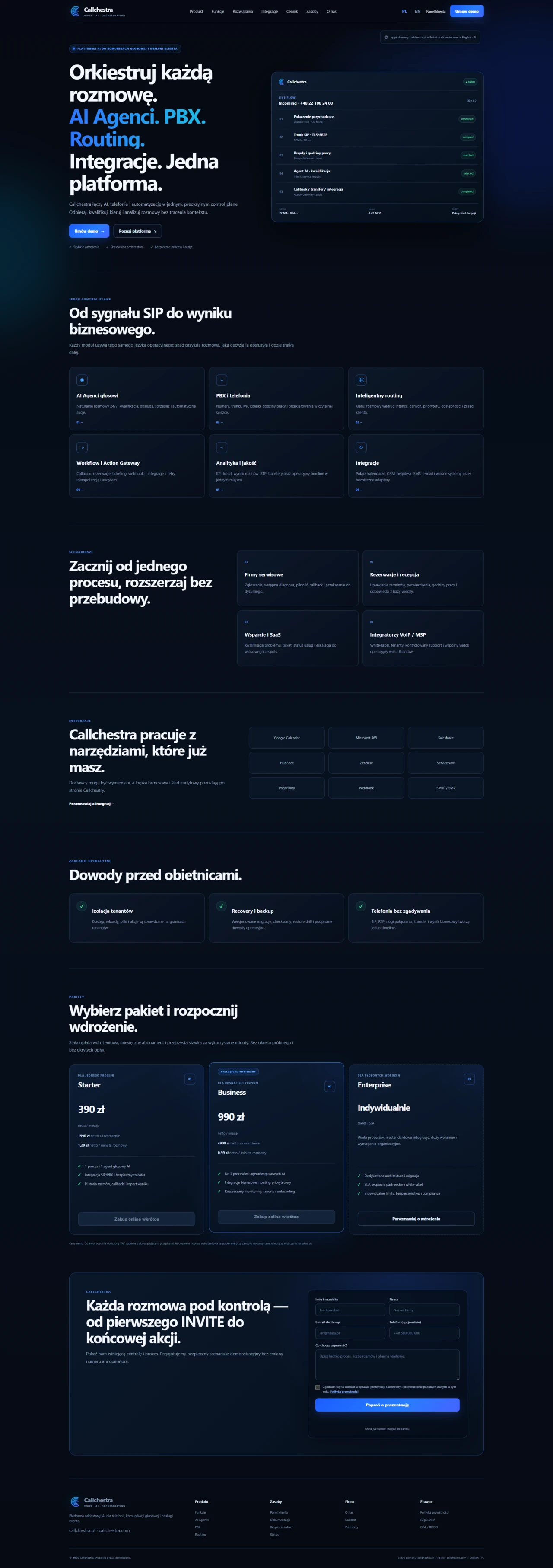
A business communication orchestration platform combining AI agents, PBX, routing, workflows, call analytics and integrations in one controlled environment.
- Product
- Communication platform
- Model
- SaaS + deployments
- Focus
- AI + PBX + routing
THE CHALLENGE
Orchestrate a call from SIP signalling to a business outcome.
Modern business communication combines traditional telephony, AI voice agents, routing, integrations and business processes. Each element can work independently, but the value emerges when the complete flow is coherent and observable.
The platform was intended to work with the customer's existing tools instead of requiring the entire environment to be replaced. This required clear integration boundaries, different deployment models and control over call quality.
At the same time, the product had to be understandable to a business audience: showing outcomes and scenarios while retaining the technical credibility needed by carriers and IT teams.
Build a platform that lets organisations deploy AI agents and telephony as a single process, with routing, integrations, analytics and operational control.
SCOPE AND DECISIONS
What was designed, and why.
The functional scope is presented alongside decisions that affect everyday use and future product development.
- 01
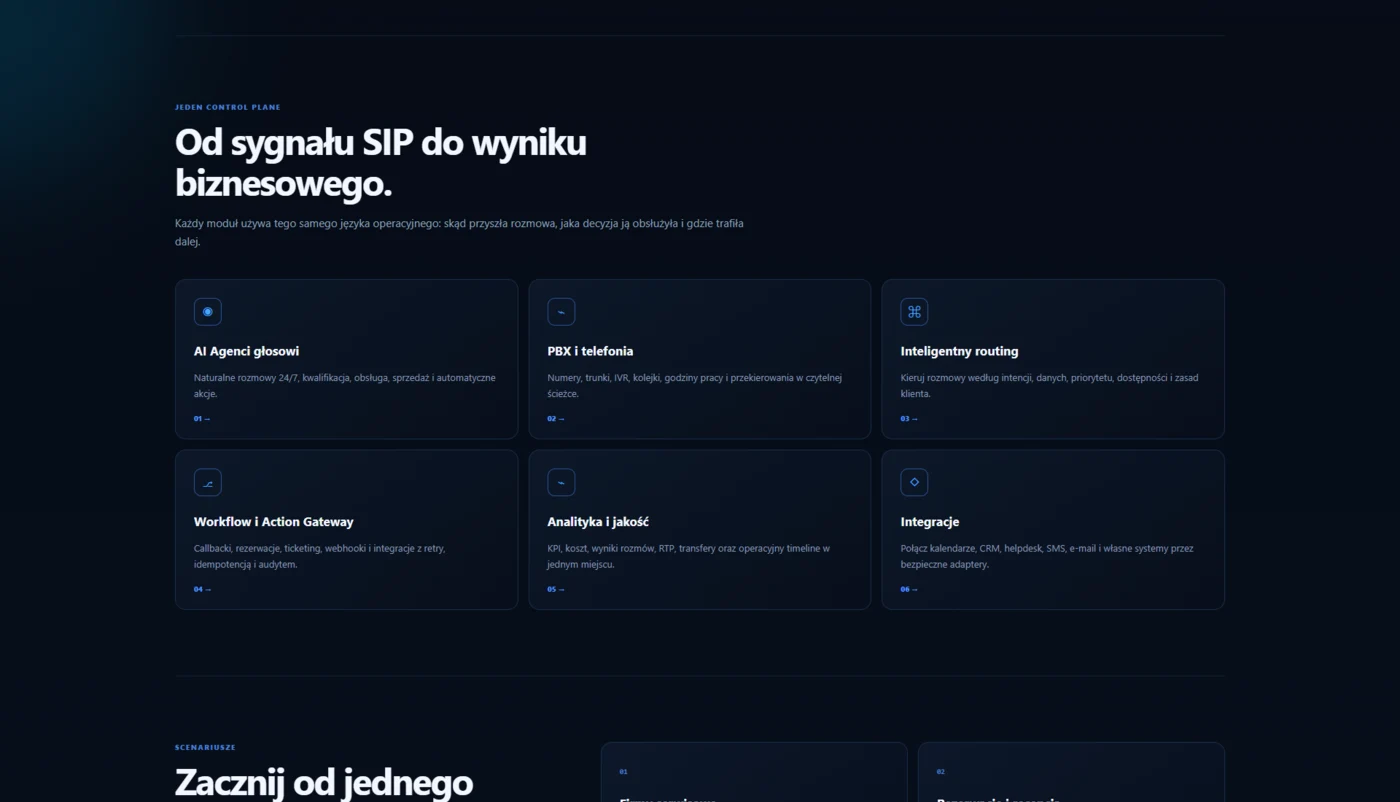
AI voice agents, conversation scenarios and automated actions.
- 02
PBX, numbers, IVR, queues, call policies and routing.
- 03
Workflows and an integration gateway to business systems.
- 04
Quality analytics, call monitoring and diagnostic paths.
- 05
SaaS models, dedicated deployments and integrations with existing infrastructure.
Orchestration rather than silos
AI, PBX and integrations are presented as one call flow, rather than a collection of independent modules.
Compatibility with existing environments
The platform is intended to extend the customer's current tools through APIs, SIP and integrations, without requiring a complete infrastructure replacement.
Operational evidence
Tenant isolation, recovery, backups and evidence-based telephony are communicated as product properties, rather than marketing promises.
Packages matched to scale
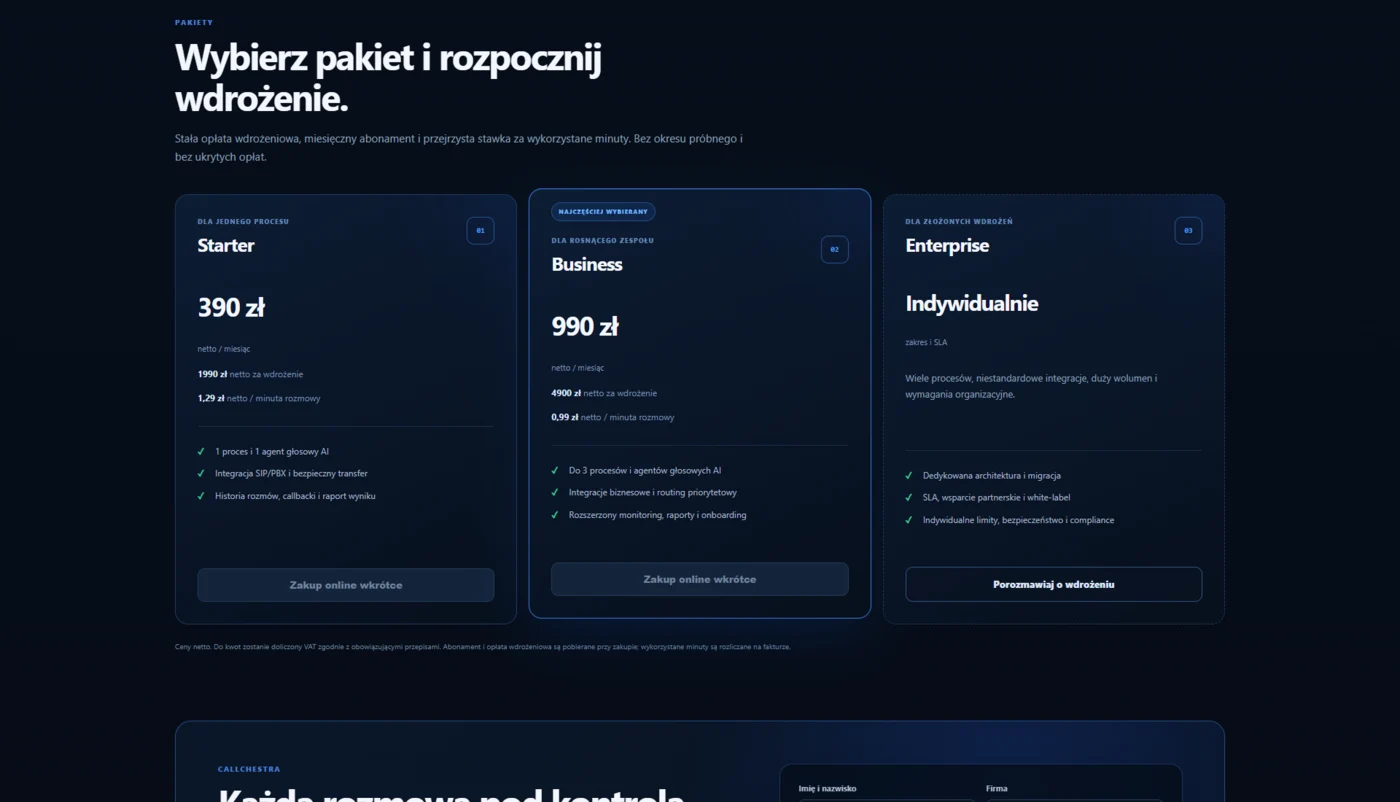
The offering separates a quick start, a business option and enterprise deployments, while retaining a shared technology foundation.
ARCHITECTURE
Product layers and their responsibilities.
The architecture is described in functional terms to make clear where logic, data, integrations and operations belong.
- 01
Panel and API → configuration, roles, scenarios and customer integrations.
- 02
AI layer → voice agents, intents, workflows and business actions.
- 03
PBX/routing engine → SIP, queues, IVR, policies and call decisions.
- 04
Integrations → CRM, helpdesk, webhooks, APIs and carrier systems.
- 05
Observability → call quality, logs, CDRs, monitoring and recovery.
SELECTED SCREENS
The interface as part of the whole process.
The screenshots show the appearance and how users are guided through the main tasks.
OUTCOME
What the project delivered.
Specific product, process and deployment capabilities delivered by the project, without invented metrics.
- One coherent product narrative for AI agents, telephony and integrations.
- A modular scope allowing a start with one process and subsequent expansion.
- Clear deployment models for service businesses, reception teams, SaaS providers and integrators.
- Technical credibility supported by observability, backups and tenant isolation.
- A foundation for developing call automation while retaining control of SIP and routing.
NEXT PROJECT
UPnator
A monitoring and reliability platform for websites, APIs, servers, databases and telephony, with alerts, status pages, incident history and SLO reports.